
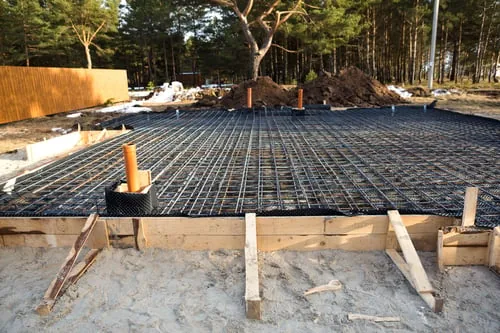
Rebar Installation
Steel reinforcement, tying and placement to spec — across Charlotte, Gastonia and 30 miles around.
Rebar Installation in Charlotte & Gaston County
Concrete is enormously strong in compression and weak in tension. Steel is the opposite. Reinforcement is what lets the two work together — and it only works if the steel is the right size, in the right place, at the right depth, properly lapped and properly tied. We provide rebar layout, fabrication, placement and tying for slabs, footings, walls, columns, piers and structural concrete throughout Charlotte and Gaston County.
Cover: the detail that decides lifespan
Concrete cover is the distance between the steel and the nearest concrete surface, and it is the single most important variable in how long a reinforced structure lasts. Too little cover and moisture, chlorides and oxygen reach the steel. The steel corrodes. Rust occupies several times the volume of the original metal, and that expansion cracks the concrete outward from the inside — the spalling you see on old bridge decks and parking structures.
Typical requirements are around three inches for concrete cast against earth, two inches for formed surfaces exposed to weather, and less for interior conditions. Those numbers are not suggestions. We hit them using proper chairs and spacers rather than bricks, stones or whatever is lying around the site, which is how cover quietly disappears on a lot of jobs.
Why we do not hook rebar up mid-pour
There is a widespread shortcut where wire mesh or rebar is laid directly on the sub-grade and then pulled upward with a hook as the concrete is placed. It is fast and it looks like it works.
It does not. The steel ends up at an inconsistent and unverifiable depth, frequently near the bottom of the slab where it contributes almost nothing to controlling surface cracking. Reinforcement in a slab generally needs to sit in the upper third to do its job. We support steel on chairs at the correct height so it stays exactly where the design put it, before, during and after the pour.
Laps, ties and continuity
Rebar transfers force between bars through lap splices — an overlap long enough for the bond with the surrounding concrete to develop the bar's full strength. Lap length depends on bar size, concrete strength and bar position, and it is commonly in the range of 30 to 40 bar diameters. Short-lapping is invisible once concrete is poured and it creates a hinge point exactly where continuity was needed.
We lap to the specified length, stagger splices so they do not all land in the same plane, and tie intersections properly. Ties are not structural in themselves — their job is to hold the mat in position against the considerable force of concrete being placed against it. A mat that shifts during a pour is a mat that is no longer where the engineer put it.
Rebar versus wire mesh
Welded wire mesh is fine for light residential flatwork where the only goal is holding shrinkage cracks tight. It is thin, it is cheap, and it is easy to install badly.
Rebar is the right choice anywhere there is real structural demand — footings, walls, columns, piers, driveways carrying vehicle loads, commercial flatwork, and any slab where differential settlement is a genuine risk. It is heavier, it costs more to place, and it gives you a slab that behaves predictably when it is loaded. If your plans call for one and a contractor quotes the other, that difference is worth asking about.
Every rebar installation project covers
- Rebar layout and placement from structural drawings
- Cutting, bending and on-site fabrication
- Mats, grids and cages for slabs, footings and walls
- Correct chair height and concrete cover control
- Proper lap splice lengths and staggered joints
- Epoxy-coated and galvanized bar where specified
- Dowelling, drill-and-epoxy for tie-ins to existing concrete
- Anchor bolt, embed and sleeve placement
Four steps from first call to final cure
Read the Drawings
We work from your structural plans or engineer's detail — bar size, spacing, cover, lap lengths and any special requirements get confirmed before material is ordered.
Fabricate & Stage
Bar is cut and bent to the schedule and staged around the pour area so placement runs efficiently and nothing gets improvised on the day.
Place, Chair & Tie
Steel is set on chairs at the specified height, spacing is verified, laps are made to length, and every intersection is tied so the mat holds position during the pour.
Verify Before Pour
We walk the mat with you or the inspector before concrete arrives — cover, spacing, laps and supports all checked while they can still be corrected.
What a careful job actually buys you
Concrete is the cheapest part of a concrete job. The base, the steel, the drainage and the cure are what decide how long it lasts.
Built to Last
Correct thickness, compacted base and real reinforcement — the three things that decide whether concrete lasts 30 years or 6.
Water Managed
Correct fall on every slab and drainage behind every wall, so stormwater leaves instead of working into the concrete.
Code Compliant
Built to pass inspection first time — right depth, right steel, right cover, documented and ready when the inspector arrives.
Cured Properly
Protected against Carolina heat and cold so the concrete actually reaches the strength you paid for.
Five habits we do not skip
Premium results come from disciplined habits, not shortcuts. This is the standard we hold on every pour, no matter the size.
Straight Answers
Itemised scope, honest timelines, and a clear no if a repair beats a replacement.
Base Done Right
Excavated to depth, soft spots removed, crushed stone compacted in lifts — not dumped and levelled.
Steel on Chairs
Rebar set at the specified height with correct cover and lap lengths. Never hooked up mid-pour.
Joints On Schedule
Control joints at correct spacing, cut within the first day before shrinkage finds its own path.
Walkthrough & Care Plan
A final walkthrough plus written guidance on when to drive on it and when to seal it.
Rebar Installation questions, answered
Other concrete services
Concrete Foundations
Footings, slabs & structural bases built to code
Learn MoreConcrete Sidewalks
Walkways, paths and ADA-compliant public sidewalks
Learn MoreConcrete Walls
Retaining, foundation and structural block walls
Learn MoreConcrete Driveways
New pours, replacements, aprons & parking pads
Learn MoreConcrete Patios
Stamped, broom and decorative backyard patios
Learn MoreGet a free estimate for rebar installation
Share a few details about your project and MJ Concrete will come back with clear next steps — no pressure, no obligation.