
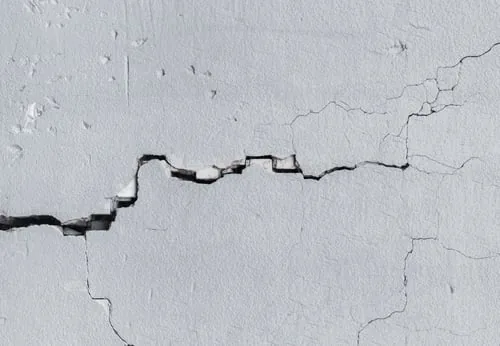
Let us start with the part most people are not told: all concrete cracks. Not most of it, not the badly built stuff — all of it. Concrete shrinks roughly one sixteenth of an inch for every ten feet as it cures, and that movement has to be released somewhere.
A well-built slab cracks where the builder decided it would, at the bottom of a tooled or saw-cut control joint, in a straight tidy line that nobody notices. A poorly built one cracks wherever the stress found its own way out. Learning to tell those apart tells you whether you have a maintenance item or a real problem.
Normal: hairline shrinkage cracks
Thin cracks, typically well under an eighth of an inch, appearing in the first weeks or months after a pour. Often running between control joints or radiating from a corner.
These are the concrete releasing curing stress. They do not open up over time, there is no vertical displacement between the two sides, and they do not affect the slab's structural performance. Sealing them is worth doing to keep water out, but there is nothing to fix.
Normal: cracks at control joints
This is the system working exactly as designed. A control joint is a deliberately weakened line — either tooled into fresh concrete or saw-cut within the first day — which gives shrinkage a predetermined place to happen.
When the slab cracks along the bottom of that joint, the joint has done its job. It is not a defect and it needs no repair beyond keeping the joint sealed.
Watch it: cracks wider than about a quarter inch
A crack you can fit a coin into is past shrinkage territory. Something is moving.
It is worth monitoring rather than panicking. Mark each end of the crack with a pencil and date it, and measure the width. If it is stable over six months, it likely released and settled. If it keeps growing, the underlying cause is still active and needs addressing before repair is worth doing.
Problem: cracks with vertical displacement
If one side of a crack sits higher than the other, you no longer have a crack — you have differential settlement. The ground under one side has moved relative to the other.
Filling this does nothing. The sub-grade is the problem, and it will keep moving. On flatwork it means excavating and rebuilding the base under the affected area. On a structural element it means finding out why the soil moved before deciding what to do about the concrete.
Problem: stair-step cracks in block or brick
Diagonal cracks following the mortar joints in a stair-step pattern through a block foundation or brick veneer are a classic indicator of foundation movement. So are horizontal cracks partway up a basement wall, which usually point to lateral soil pressure.
These warrant a proper assessment. Sometimes the cause is simple and fixable — a failed downspout saturating one corner of the foundation for years. Sometimes it needs structural engineering. Either way, cosmetic patching without diagnosis is money wasted.
Problem: map cracking across a whole slab
An interconnected web of cracks covering the majority of a slab means the concrete has lost uniform support. The base has failed, and the slab is bridging voids.
There is no repair for this that lasts. The slab needs to come out, the base needs to be rebuilt and compacted properly, and new concrete needs to go down at the correct thickness with appropriate reinforcement.
Problem: crumbling, flaking and exposed aggregate
Surface scaling is not really a crack, but it is the other thing people call us about. The top layer flakes away leaving the stone exposed.
The usual causes are freeze-thaw cycling, deicing salts, or a mix that had water added on site to make it easier to finish — which weakens the surface paste permanently. Localised scaling can be resurfaced. Widespread scaling means the wearing surface is gone across the whole slab, and an overlay will debond.