
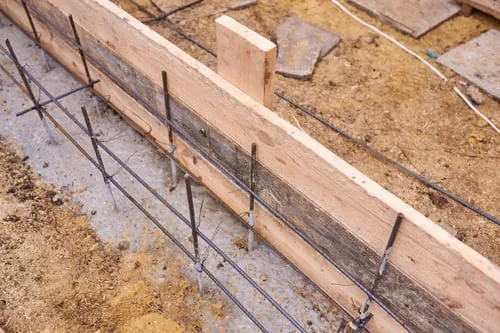
Almost every conversation about a concrete quote focuses on the concrete — how many yards, what strength, how thick. Those things matter. But when a slab or a footing fails early, the concrete is rarely the culprit. The reinforcement is.
Concrete handles compression brilliantly. Push down on it and it barely notices. Pull it apart, bend it, or make it span an unsupported gap, and it fails at a fraction of that strength. Steel does the opposite — it is superb in tension. Reinforced concrete works because the two materials cover each other's weaknesses. But only if the steel is actually where the design intended.
Concrete cover is the whole ballgame
Cover is the distance between the steel and the nearest concrete surface. It is the single biggest factor in how long a reinforced structure survives, and it is invisible the moment the pour is finished.
Concrete is highly alkaline, and that alkalinity forms a thin passive layer on the surface of embedded steel that stops it corroding. Maintain enough cover and rebar will sit inside concrete for a century without meaningful rust. Cut that cover short and moisture, oxygen and chlorides reach the bar. It corrodes. Rust occupies several times the volume of the steel it came from, and that expansion cracks the concrete outward from the inside. That is exactly what you are looking at on a spalling parking deck or a crumbling bridge column.
Typical requirements run around three inches for concrete cast directly against earth, two inches for formed surfaces exposed to weather, and less for protected interior conditions. Those are minimums, not targets to shave.
The hooking shortcut, and why we do not use it
There is a common practice where wire mesh or rebar is laid flat on the sub-grade, then pulled up with a hook as concrete is being placed. It is quick, it requires no chairs, and it looks like it works.
It does not. The steel ends up at whatever height the hook happened to lift it to at that moment — inconsistent along the slab, impossible to verify afterwards, and very often sitting near the bottom where it does almost nothing to control surface cracking. Reinforcement in a slab generally needs to be in the upper third to resist the tensile stresses that actually cause cracks to open.
The alternative costs a small amount of plastic and a bit of labour: rebar chairs at the specified height, spaced closely enough that the mat does not sag between them. The steel is then exactly where the engineer put it, before the pour, during the pour, and forever after.
Lap splices are not a formality
Rebar comes in finite lengths, so bars have to be spliced. In most reinforced concrete that is done by simply overlapping two bars — a lap splice — and letting the bond between steel and concrete transfer the force from one to the other.
The overlap has to be long enough for that transfer to develop the bar's full strength, commonly in the range of 30 to 40 bar diameters depending on bar size, concrete strength and position. Lap short and you have created a hinge point at precisely the location where continuity mattered. It is completely invisible once concrete is placed.
Splices should also be staggered rather than all landing in the same plane, so the weakest points are distributed rather than lined up in a row across the member.
Ties do not add strength — they hold position
A frequent misunderstanding is that tie wire contributes to the structural performance of a rebar mat. It does not. Its only job is to keep the mat in position.
That job is more demanding than it sounds. Placing concrete against a rebar cage involves real force: vibration, the weight of the mix, workers moving across the mat, the discharge from a pump or chute. An untied or lightly tied mat shifts. Once it has shifted, bar spacing is wrong, cover is wrong, and none of it can be corrected.
Mesh or rebar?
Welded wire mesh is genuinely appropriate for light residential flatwork where the only objective is holding shrinkage cracks tight so they stay hairline instead of opening up. It is thin and inexpensive.
Rebar belongs anywhere there is real structural demand — footings, walls, columns, piers, driveways carrying vehicle loads, commercial flatwork, and any slab where the sub-grade might settle unevenly. If your drawings specify rebar and a bid comes back priced around mesh, that difference is worth a direct question. It is one of the most common places a low bid finds its savings.