
The most common question we get on a driveway estimate is whether it can be repaired instead of replaced. It is a fair question and the honest answer is: sometimes.
Repair is genuinely the right call for isolated damage on an otherwise sound slab. It is money thrown away when the underlying problem is the base, the thickness or the age of the concrete — because the patch will fail the same way, usually faster. Here is how to tell the difference.
1. Cracks that form a map across the whole slab
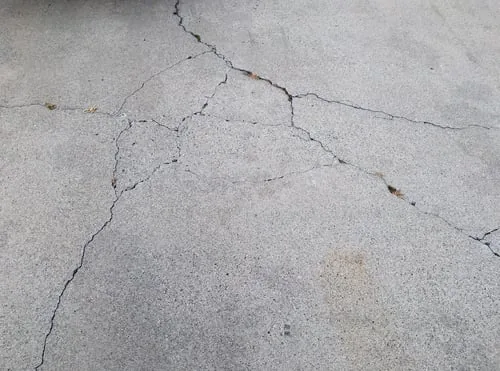
A single straight crack running from a joint is normal and usually harmless — concrete shrinks as it cures and that shrinkage has to go somewhere. A network of interconnected cracks spreading across the entire driveway is something else entirely.
Map cracking on that scale means the slab has lost uniform support underneath. The base has settled unevenly, or was never compacted properly, and the concrete is now spanning voids it was never designed to span. Patching individual cracks does nothing about the voids. The slab will keep breaking up.
2. Sections sitting at different heights
Run your eye along the driveway from the street. If adjacent panels sit at visibly different heights, or a section has tipped, the sub-grade beneath has moved.
Small offsets can sometimes be addressed by grinding or mudjacking. Once you are looking at an inch or more, or several panels involved, you have a base problem rather than a concrete problem — and the only durable fix is to excavate, rebuild the base properly and re-pour.
3. The surface is pitting, flaking or crumbling
Scaling and spalling — where the top layer flakes off and leaves exposed aggregate — usually come from freeze-thaw damage, deicing salts, or concrete that was overworked or had water added on site to make it easier to finish.
If it is confined to one area, resurfacing is a reasonable option. When scaling covers most of the driveway, the surface layer has lost its integrity across the board and an overlay will simply debond and fail. Replacement is the honest answer.
4. Water pools on it after rain
Standing water after a storm means the slope is wrong — either it was poured that way, or the slab has settled into a low spot.
This is worth taking seriously beyond the puddle itself. Standing water works into the concrete's pores, then freezes and expands during a cold snap, which is precisely how surface deterioration starts. Worse, if the water is pooling toward the house, you are directing every rainstorm at your foundation. Slope cannot be corrected after the fact on a flat slab. It has to be built in with the forms.
5. It is more than 25 or 30 years old
A well-built concrete driveway should last 30 years or more. Many in this area were not built that way — poured at three or four inches over minimal base because that was the standard at the time and the vehicles were lighter.
Age alone is not a reason to replace something that is performing. But if a driveway is thirty years old and showing several of the symptoms on this list, spending money on repairs is buying a couple of years at best.
6. You have patched it more than once already
This one is simple arithmetic. If you have paid for two or three rounds of crack filling, section replacement or resurfacing in the last few years, add up what you have spent. It is frequently a meaningful fraction of a full replacement — and you still have an old driveway that will need work again next year.
At that point replacement is not the expensive option. It is the one that stops the bleeding.
7. Cracks are wide enough to be a hazard
Hairline cracks are cosmetic. Cracks wide enough to catch a shoe, a stroller wheel or a walking stick are a trip hazard, and on a commercial property that is a genuine liability exposure.
The same applies to vertical offsets between panels. Once one section has lifted above its neighbour by more than about a quarter inch, it is a hazard whether or not the rest of the slab looks fine.
What replacement actually involves
Done properly: demolition and removal of the old slab, excavation to depth, four to six inches of compacted crushed stone base, forms set to establish correct slope away from the house, rebar on chairs where vehicle loads justify it, five to six inches of concrete, and control joints cut at proper spacing within the first day.
A typical residential driveway runs three to five working days. Foot traffic after 24 to 48 hours, cars after seven days, and heavy vehicles after the full 28-day cure. Rushing that last part is the fastest way to crack a slab that would otherwise have lasted decades.