
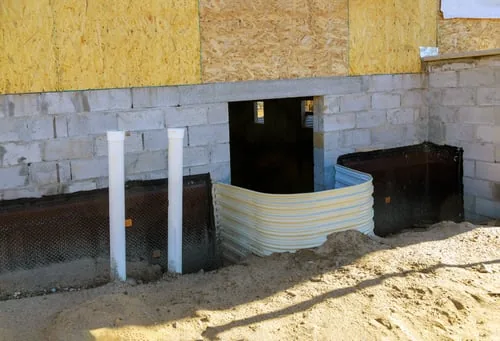
If you asked us to name the single most common reason concrete structures fail around Charlotte, it would not be bad concrete, thin slabs or skipped rebar. It would be water that had nowhere to go.
Drainage is unglamorous. It is buried, invisible when finished, and easy to omit from a bid without the customer ever knowing. It is also the difference between a foundation wall that stands for fifty years and one that starts bowing inside five.
Piedmont clay and hydrostatic pressure
The red clay under most of this region has two relevant properties: it holds water, and it changes volume as its moisture content changes. It swells when wet and shrinks as it dries.
Saturated soil against a below-grade wall exerts hydrostatic pressure — the weight of the water itself pushing laterally. It can nearly double the load a wall was designed for. A structure engineered for drained backfill and then buried in saturated clay is being asked to do something it was never sized to do, and the result is bowing, horizontal cracking, or outright failure.
The seasonal swell-and-shrink cycle adds a second problem. Clay pulling away from a wall in a dry summer, then expanding hard against it after a wet autumn, works that wall back and forth year after year.
What a proper drainage system actually is
There are four components and all four matter.
First, drainage stone: clean, angular, washed gravel placed directly against the back of the wall. Angular is important — it interlocks and maintains voids for water to travel through. Rounded pea gravel compacts and closes those voids up.
Second, filter fabric wrapping that stone. Without it, fine clay particles migrate into the gravel over a few seasons and clog it completely. A drainage layer full of silt is not a drainage layer, and this is the most common way a system that was installed correctly stops working.
Third, a perforated drain pipe at the base of the wall, laid to fall, and — critically — daylighted somewhere water can actually escape. A drain pipe that terminates in the middle of the backfill is decoration.
Fourth, damp-proofing or waterproofing on the wall face itself. These are not the same thing. Damp-proofing resists moisture vapour. Waterproofing is a membrane that resists liquid water under pressure. Which you need depends on how much water your site actually handles.
Surface water is half the battle
Everything above deals with water that has already reached the soil against your wall. It is far cheaper to stop it getting there.
That means gutters that are actually clear, downspouts discharging well away from the foundation rather than dumping at the corner of the house, and finished grade sloping away from the structure — roughly six inches of fall over the first ten feet is the usual guidance.
It also means the flatwork. A driveway, walkway or patio sloped the wrong way is a purpose-built channel delivering stormwater to your foundation. We see it constantly, and it is entirely avoidable at the time of the pour.
Retaining walls follow the same rules
Everything above applies with more force to retaining walls, because a retaining wall's entire purpose is holding back soil that wants to move.
When you see a wall in a neighbourhood bulging outward in the middle, leaning forward at the top, or with courses that have separated, you are almost always looking at a wall with no functioning drainage behind it. The soil got saturated, the pressure exceeded what the wall could resist, and it moved. Walls very rarely straighten out on their own — the movement tends to accelerate once it starts.
Why it gets left out of bids
Drainage is invisible in the finished product. Nobody looks at a completed wall and sees the gravel, the fabric and the pipe behind it. That makes it the easiest line item to quietly delete when a contractor is trying to come in under a competing bid.
It is also the reason two quotes for what sounds like the same wall can differ substantially. If you are comparing prices, ask each contractor specifically what goes behind the wall — stone type, filter fabric, drain pipe, and where that pipe daylights. The answers will tell you a great deal about which number is real.